
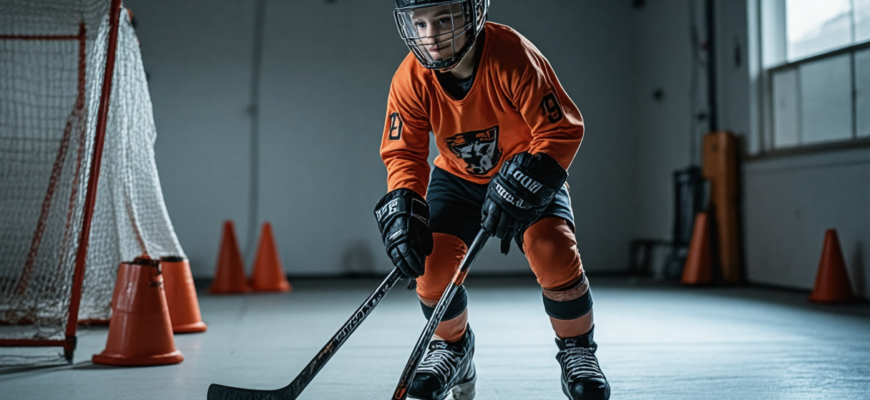
Improving puck handling is a crucial element for any aspiring hockey player. Whether you’re a beginner aiming to build foundational skills or an experienced player seeking to refine your finesse on the ice, developing excellent puck control can significantly elevate your game. Fortunately, many effective drills and exercises can be performed at home or in your personal training space, without the need for elaborate equipment or ice rinks. This comprehensive guide will walk you through the essentials of puck handling, provide actionable tips, and outline specific workouts to take your skills to the next level from the comfort of your home.
- Understanding the Importance of Puck Handling in Hockey
- Fundamental Elements of Good Puck Handling
- Common Challenges in Puck Handling
- How to Practice Puck Handling at Home
- Preparation and Equipment
- Drills and Exercises to Improve Puck Handling
- Stickhandling in a Small Area
- Figure Eight Drills
- Toe Drag and Poke Check Exercises
- Walk-the-Line
- Two-Puck Control
- Off-Hands Puck Handling
- Speed and Reaction Drills
- Incorporating Strength and Flexibility into Your Routine
- Additional Tips for Effective Practice
- Advanced Puck Handling Techniques to Master
- Spin Moves
- Body Feints and Fakes
- One-Handed Stickhandling
- Summary: Building a Home Routine for Puck Handling Mastery
- Sample Weekly Training Schedule
Understanding the Importance of Puck Handling in Hockey
In hockey, puck handling refers to a player’s ability to control, maneuver, and execute precise movements with the puck during gameplay. This skill influences a player’s speed, agility, and overall effectiveness on the ice. Proper puck handling allows players to evade opponents, set up offensive plays, and maintain possession under pressure. It also plays a key role in improving shooting accuracy and passing precision, making it an essential component of the game.
Fundamental Elements of Good Puck Handling
- Stick control: Maintaining a firm but flexible grip to manipulate the puck seamlessly.
- Hand-eye coordination: Seeing the puck and reacting quickly to its movement.
- Balance and posture: Keeping a stable stance for quick changes in direction.
- Footwork: Moving efficiently to create space and evade defenders.
- Speed and agility: Developing quick stick and body movements for dynamic puck control.
Common Challenges in Puck Handling
Many amateur players struggle with maintaining control under pressure, developing dexterity with both hands, or executing precise movements at speed. Other frequent issues include:
- Holding the puck too rigidly, which impairs agility.
- Overextending or losing stick control during rapid maneuvers.
- Insufficient practice on both forehand and backhand handling.
- Lack of confidence with using the non-dominant hand.
How to Practice Puck Handling at Home
Preparation and Equipment
To maximize your training efficiency, gather basic equipment that can be used at home:
- Hockey stick: A standard or junior stick appropriate for your size.
- Puck or puck substitute: A training puck, a small rubber ball, or a roller skate wheel (if permitted).
- Cones or markers: To create drills and obstacle courses.
- Gloves and protective gear: Optional but recommended for safety during intensive drills.
Note that actual ice is not necessary for many puck handling drills. Use a smooth, flat surface such as a hardwood floor, garage floor, or driveway concrete.
Drills and Exercises to Improve Puck Handling
-
Stickhandling in a Small Area
Set up a confined space, such as between two cones or lines, and practice quick, controlled stickhandling movements back and forth. Focus on keeping the puck close to the blade for better control. Try to increase speed gradually while maintaining precision.
-
Figure Eight Drills
Create a figure-eight pattern using two markers placed about 1 meter apart. Dribble the puck around the markers, switching hands and adjusting speed to simulate game situations. This drill enhances hand-eye coordination and improves ambidextrous puck handling.
-
Toe Drag and Poke Check Exercises
Practice “toe drag” (pulling the puck back with the toe of your blade while changing direction) and poke checks to intercept an imaginary opponent. These movements develop dexterity and situational awareness.
-
Walk-the-Line
Place a straight line on the floor. Dribble the puck along the line, maintaining control without stepping off. Increase difficulty by trying to do it with your eyes closed or one-handed.
-
Two-Puck Control
Place two pucks and try to control both simultaneously, switching between them effortlessly. This enhances multitasking and concentrate on maintaining control over multiple objects.
-
Off-Hands Puck Handling
Use your non-dominant hand to control the puck. This builds ambidextrous skill and confidence, which are crucial during fast-paced game situations.
-
Speed and Reaction Drills
Use a reactive partner or a timer to perform quick stickhandling sequences, simulating game pressure. Work on executing commands or switching directions rapidly.
Incorporating Strength and Flexibility into Your Routine
Effective puck handling isn’t solely about practicing stick control; physical conditioning plays a significant role. Incorporate exercises that enhance flexibility, core strength, wrist and forearm muscles, and overall agility:
| Exercise | Benefits | Sample Routine |
|---|---|---|
| Wrist curls and extensions | Builds wrist strength for better puck control | 3 sets of 15 reps each |
| Planks and core exercises | Improves balance and stability | Hold for 30-60 seconds, 3 rounds |
| Jumping rope or agility ladder drills | Enhances speed and footwork | 10-15 minutes daily |
| Stretching routines (hamstrings, quads, hips) | Aids flexibility and injury prevention | Daily 10-minute stretching session |
Additional Tips for Effective Practice
- Consistency is key: Practice regularly, ideally daily or several times a week.
- Set specific goals: Focus on particular skills each session, such as improving backhand control or quick passes.
- Record your progress: Use video recordings to analyze form and technique, then adjust accordingly.
- Gradually increase difficulty: As skills improve, incorporate more complex drills, faster speeds, or tighter spaces.
- Simulate game scenarios: Create drills that mimic in-game situations, like dodging imaginary defenders or executing quick one-touches.
Advanced Puck Handling Techniques to Master
Once basic skills are solidified, players can focus on more advanced moves to elevate their play:
-
Spin Moves
Perfect for evading defenders; involve spinning quickly while maintaining puck control to change direction abruptly.
-
Body Feints and Fakes
Use subtle body movements to deceive opponents and create space for a shot or pass.
-
One-Handed Stickhandling
Develops strength and dexterity in your bottom hand, essential for quick maneuvers and shots.
Summary: Building a Home Routine for Puck Handling Mastery
Consistent, focused practice is vital for mastering puck handling skills. By integrating a mix of drills, physical conditioning, and advanced techniques into your routine, you can significantly improve your control, agility, and overall game performance. Remember to track progress, set achievable goals, and gradually increase the challenge to keep motivation high and skill development continuous.
Sample Weekly Training Schedule
| Day | Focus | Activities |
|---|---|---|
| Monday | Fundamentals | Stickhandling in small area, figure eight drills |
| Tuesday | Strength & Flexibility | Wrist exercises, stretching, core workouts |
| Wednesday | Speed & Reaction | Speed drills, reaction exercises with partner |
| Thursday | Ambidextrous Control | Off-hand puck handling, two-puck control |
| Friday | Advanced Techniques | Spin moves, fake maneuvers, body feints |
| Saturday | Simulated Game Situations | Full-speed drills, decision-making under pressure |
| Sunday | Rest & Recovery | Stretching, light mobility exercises |
Elevating your puck handling skills at home is entirely achievable with dedication, the right exercises, and consistent effort. By focusing on fundamental control, physical conditioning, and gradually adding complexity to your drills, you can develop the finesse and confidence needed to excel on the ice. Remember, mastery comes with time, patience, and persistence—so stay motivated and enjoy the process of becoming a better hockey player from your personal practice space.
Похожие записи:
 Essential Hockey Drills to Elevate Your Skills at Home or During Practice
  Essential Stickhandling Drills for New Hockey Players: Improve Your Skills on Ice
  Mastering Hockey Stick Handling: Essential Techniques for Beginners
  Mastering Passing and Receiving the Puck: Essential Skills for Amateur Hockey Players
  Mastering the Fundamentals of Puck Retrieval and Chase in Hockey: Essential Skills for Amateur Players
  Building Confidence in Your Skating and Puck Skills: A Complete Guide for Amateur Hockey Players
  Mastering Puck Possession: Essential Techniques for Amateur Hockey Players
  Mastering Faceoff Techniques: The Key to Gaining Puck Control in Hockey
  Mastering Precision: Essential Drills to Improve Passing Accuracy in Hockey
  Mastering Consistency: Proven Strategies to Stay Motivated and Improve in Hockey for Amateurs
  Maximize Your Hockey Skills: Expert Video Analysis Tips to Elevate Your Technique
  Effective Simple Drills to Boost Puck Control and Agility for Amateur Hockey Players
  Mastering the Art of Puck Recovery: Strategies for Effective Play in Amateur Hockey
  Mastering the Art of Precision: How to Improve Your Hockey Shooting Accuracy
  Mastering the Art of Following a Hockey Game’s Flow: Essential Tips for Amateur Players to Improve Awareness
  Mastering Recovery and Rebound Control: Essential Skills for Amateur Hockey Players