Hockey is a fast-paced and physically demanding sport that requires players to develop a wide range of skills. Among these, passing accuracy stands out as one of the most critical for effective gameplay. Precise passing allows teams to maintain possession, create scoring opportunities, and outmaneuver opponents. Whether you’re an amateur enthusiast looking to elevate your skills or a beginner aiming to learn the fundamentals, mastering passing accuracy is a foundational step toward becoming a better hockey player.
- Understanding the Importance of Passing Accuracy in Hockey
- Fundamental Principles of Accurate Passing
- Essential Drills to Develop Passing Accuracy
- 1. Wall Passing Drill
- How to do it:
- Focus points:
- 2. Partner Passing with Targets
- How to do it:
- Tips for success:
- 3. Moving Pass Drill
- How to do it:
- Advantages:
- 4. Passing Into a Net or Goal
- How to do it:
- Pro tip:
- Advanced Techniques to Improve Passing Precision
- 1. One-Touch Passing Drills
- 2. Switch and Shuffle Passing
- 3. Simulated Game Drills
- Common Mistakes and How to Correct Them
- Monitoring Progress and Setting Goals
- Additional Resources
- Mathematical Formula for Passing Power Control
- Final Thoughts
Understanding the Importance of Passing Accuracy in Hockey
Passing accuracy directly impacts the flow of the game. Even the most skilled skaters can find themselves ineffective if their passes are inconsistent or off-target. Accurate passing:
- Maintains team possession
- Creates scoring chances
- Forces opponents into defensive mistakes
- Builds player confidence and teamwork
Developing reliable passing skills requires deliberate practice and familiarity with fundamental drills. The following sections describe essential exercises designed to enhance passing precision, strengthen technique, and build confidence on the ice.
Fundamental Principles of Accurate Passing
Before diving into specific drills, it’s important to understand the key principles that underpin accurate passing in hockey:
- Preparation: Properly position your body, stick, and eyes on the target before executing the pass.
- Stickhandling and Control: Maintain control of the puck to ensure smooth, precise passes.
- Force and Power: Adjust the strength of your pass according to distance and game context, avoiding excessive force or softness.
- Follow-Through: Complete the motion with a proper follow-through to ensure accuracy and consistency.
3>Body Positioning: Use skating and body movement to align correctly with your teammates or intended target.
Essential Drills to Develop Passing Accuracy
Implementing targeted drills into regular practice routines can dramatically improve your passing skills. Here are some of the most effective exercises, suitable for players of all levels:
1. Wall Passing Drill
This classic drill helps develop both passing accuracy and receiving control. It can be performed individually or in pairs.
How to do it:
- Stand about 2-3 meters away from a sturdy wall.
- Holding your stick firmly, pass the puck against the wall with controlled force.
- Watch the puck rebound back, and aim to catch or control it smoothly.
- Repeat the process, varying the passing angle and force to simulate game situations.
Focus points:
- Maintain a low, balanced stance for better control.
- Focus on precise stick positioning and follow-through.
- Use both forehand and backhand passes to develop versatility.
2. Partner Passing with Targets
This drill emphasizes accuracy over distance and develops the ability to aim at specific targets.
How to do it:
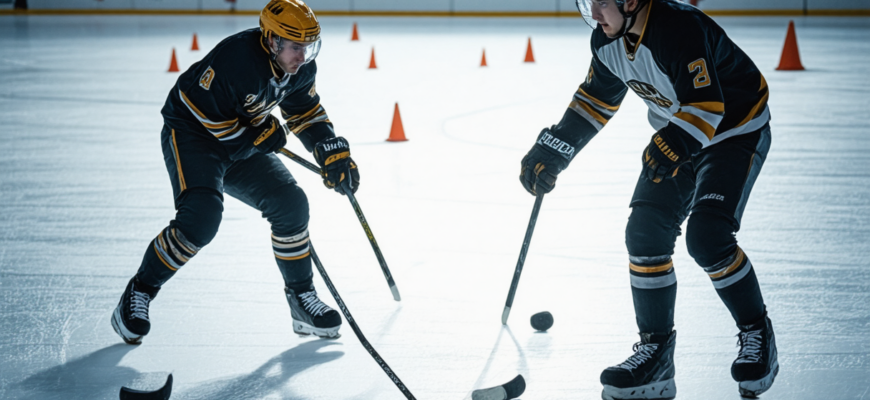
- Set up cones, markers, or designated targets at various distances and angles.
- Partner or coach stands at a designated position holding a puck.
- Pass the puck accurately onto each target, adjusting power and angle accordingly.
- Increase difficulty by moving targets or changing the distance.
Tips for success:
- Keep your eyes on the target and maintain proper body alignment.
- Use your wrists and arms to control the pass, avoiding unnecessary force.
- Repeat until consistent accuracy is achieved.
3. Moving Pass Drill
This exercise simulates in-game scenarios where players must pass while skating, improving both passing and skating coordination.
How to do it:
- Set up a line of cones or markers along the ice, about 10-15 meters apart.
- Skate smoothly from one cone to the next, passing the puck to a partner positioned at each cone.
- Pass the puck accurately, leading the receiver and adjusting for movement.
- Alternate between forehand and backhand passes, and incorporate changes in speed and direction.
Advantages:
- Enhances passing accuracy on the move.
- Improves coordination between skating and puck handling.
- Mimics real-game passing situations.
4. Passing Into a Net or Goal
Target practice with a goal or net trains precise placement under pressure and improves under realistic conditions.
How to do it:
- Place a net or target zone at the end of the ice or rink.
- From various distances and angles, pass the puck into the net or designated area.
- Vary the passes by changing precision, power, and direction.
- Include game-like distractions such as movement or simulated defender pressure if possible.
Pro tip:
Use markers or tape inside the net to designate scoring zones for more precise targeting.
Advanced Techniques to Improve Passing Precision
Once foundational drills become routine, players should incorporate more advanced techniques to further sharpen their skills:
1. One-Touch Passing Drills
Practicing one-touch passes increases reflex speed and decision-making ability, crucial for tight game situations.
2. Switch and Shuffle Passing
Enhances adaptability by passing while changing direction or body orientation, improving versatility in real game scenarios.
3. Simulated Game Drills
Involves small-sided games or drills that mimic real match conditions, forcing players to execute accurate passes under pressure.
Common Mistakes and How to Correct Them
Even experienced players can develop bad habits affecting passing accuracy. Recognizing and correcting these mistakes is vital:
- Overpushing the puck: Use controlled, appropriate force for the distance.
- Poor body positioning: Maintain proper stance to ensure balance and targeting accuracy.
- Looking at the puck: Keep your eyes on the target, not the puck.
- Incomplete follow-through: Finish your pass with a smooth motion for better accuracy.
Monitoring Progress and Setting Goals
Tracking improvements helps maintain motivation and ensures consistent development:
- Record success rates during drills.
- Set specific targets, such as hitting a certain number of targets within a time frame.
- Seek feedback from coaches or experienced players.
- Gradually increase drill difficulty to challenge yourself.
Developing passing accuracy in hockey is a continuous process that combines technical training with strategic practice. By incorporating dedicated drills into regular routines, players of all levels can significantly improve their passing skills. Remember, patience and consistency are key. As accuracy increases, so does confidence, ultimately contributing to better teamwork and more successful game performances. Whether practicing solo or with teammates, focusing on fundamental principles and leveraging targeted exercises will lead to noticeable progress and elevate your hockey game to the next level.
Additional Resources
| Drill Name | Skills Developed | Recommended Frequency |
|---|---|---|
| Wall Passing | Control, technique, accuracy | Daily, 10-15 minutes |
| Partner Target Passing | Precision, focus | 2-3 times per week |
| Moving Pass | Coordination, skating, passing in motion | Weekly |
| Target into Net | Placement, consistency | Weekly |
Mathematical Formula for Passing Power Control
To quantify the relationship between distance, force, and accuracy, consider the following simplified formula:
P = (D × F) × C
- P — Pass accuracy score (higher is better)
- D — Distance to target (meters)
- F — Force applied (newtons)
- C — Control factor related to stick precision (range 0–1)
This formula highlights that as distance increases, more force and control refinement are required to maintain accuracy.
Final Thoughts
Improving passing accuracy is a vital aspect of becoming a proficient hockey player. Through dedicated practice, understanding fundamental principles, and employing targeted drills, players can develop the consistency and precision necessary to excel on the ice. Remember that progress takes time, and regular evaluation along with adjustments will ensure continuous improvement. With perseverance and disciplined training, achieving high passing accuracy is an attainable goal that will significantly elevate overall game performance.
Похожие записи:
 Effective Passing Drills to Boost Teamwork in Hockey for Amateurs
  Mastering Passing and Receiving the Puck: Essential Skills for Amateur Hockey Players
  Essential Stickhandling Drills for New Hockey Players: Improve Your Skills on Ice
  Mastering the Art of Following a Hockey Game’s Flow: Essential Tips for Amateur Players to Improve Awareness
  Ultimate Guide to Drills that Boost Eye and Hand Coordination for Amateur Hockey Enthusiasts
  Mastering the Basics: Wrist Shot and Slap Shot Techniques in Hockey for Amateurs
  Mastering the Art of Shooting with a Stick in Hockey: The Ultimate Guide for Beginners
  Mastering the Fundamentals of Puck Retrieval and Chase in Hockey: Essential Skills for Amateur Players
  Mastering the Ice: Essential Defensive Positioning Strategies in Hockey for Amateurs
  Incorporating Fun Drills to Enhance Hockey Skills: A Guide for Amateur Players
  Starting with Beginner-Friendly Hockey Drills: A Complete Guide for Amateur Players
  Essential Offensive Strategies in Hockey for Amateur Players
  Mastering Puck Possession: Essential Techniques for Amateur Hockey Players
  Effective Simple Drills to Boost Puck Control and Agility for Amateur Hockey Players
  Mastering Hockey Stick Handling: Essential Techniques for Beginners
  Mastering the Art of Puck Recovery: Strategies for Effective Play in Amateur Hockey